If these beams could talk
Unassuming landmark has stood time’s test
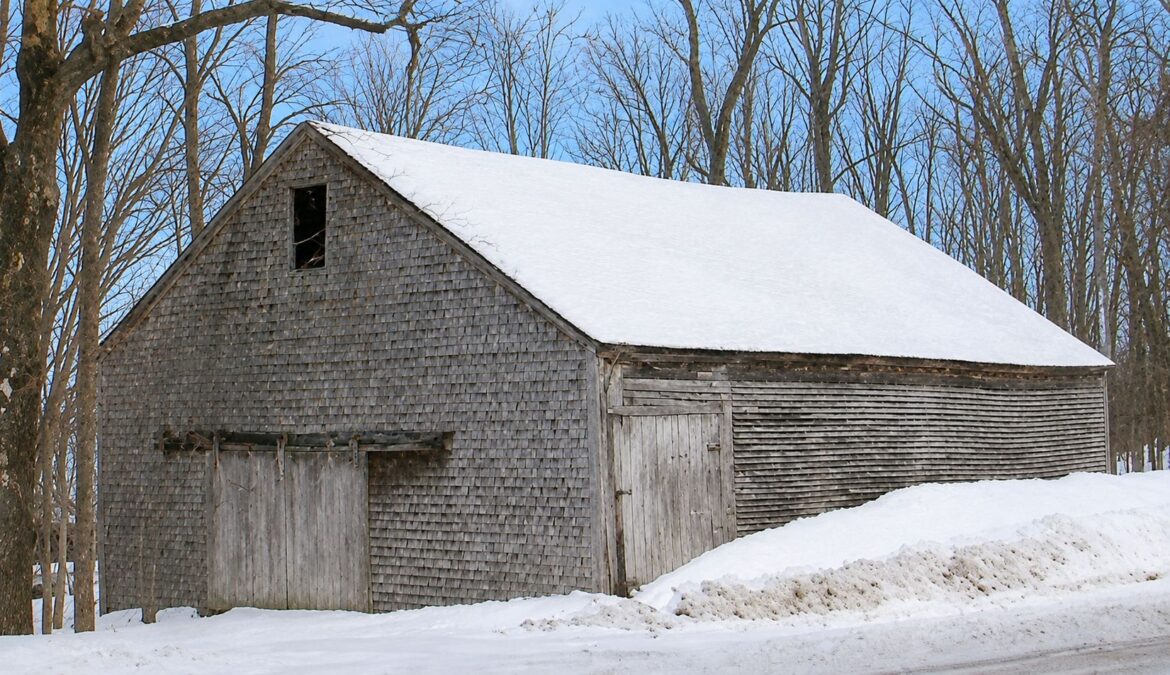
There are still a good number of barns in West Gray; Don Boulanger owns an old one on Route 202 across from Cambell Shore Road. The area has a lot of history. Boulanger’s wife, Shirley, runs West Gray Antiques in the old E.G. Barton general store. David Knudsen, 80, grew up on nearby Knudsen Road and recalls when there was an old hand-crank gas pump out front. Folks used to gather upstairs for potluck suppers. He said adults would play a card game called “63.”
This barn is very old. Some folks with memories of years ago remember this structure by the side of the road. Carlton Skilling, 81, lives on Cambell Shore Road and remembers skiing on a hill behind this barn as a kid. He said the barn looks about the same then as it does now. Before Boulanger bought this property in the early 70s, Skilling says it belonged to Irving Frank.
Hubert Cobb, 75, also lives on Cambell Shore Road. He said the barn belonged to his third great-grandfather, Joseph Allen Jr. Cobb said the Allens owned a few farms along West Gray Road during the first part of the nineteenth-century, including the barn ar 226 West Gray Road (featured in this series on 12/14/2007, “A Fox in the Hen House”) that was used as a chicken barn during the mid-20th-century. Cobb said Joseph Allen Sr. owned that particular barn. But this one went with a farmhouse across the street, as the Allens owned parcels both sides of the road. Sometime after Allen, Cobb said a woman named Dora Bailey took over this property in the early 1900s. Cobb belongs to the Gray Historical Society and said Bailey operated this beam as a store at some point, and it was likely a cooper shop for a time.
Today, Don Boulanger, 68, holds title to this property. Boulanger grew up in Westbrook and has lived here since the early 70s. He rehabs antiques in his shop directly behind this barn, which is used for storage. Any animals that belonged here were long gone when Boulanger arrived. He confirms that the barn went with a farmhouse across the street. Though grown up now, the area around this barn was a field.
This barn is a real oldie, and exhibits a different technique as far as how the bents were constructed for raising. Old barns are comprised of a series of bents, or timber trusses. There are six in this barn, which measures 40-by-50. Though covered over in short, weathered clapboards, this barn has a hand-hewn frame clad in vertical boarding. The clapboards must have been put on at a later date because there are battens covering the gaps between the boards on the inside that made it weather tight. These thin battens display rough, vertical saw marks, another indication that this is a very old barn. Circular saw marks, generally not seen until the mid-1800s, are more modem.
The roof is a major rafter and purlin system that’s also clad in vertical boarding. Boulanger is unsure of a specific date, but he remembers an old sign, since gone, that said 1780-something. The construction details in the barn indicate it could certainly be from that era. It is built in the traditional style and was likely not constructed after the 1840s. This was a workingman’s barn. The foundation is the most rudimentary of designs, just randomly laid round rocks. The center is supported with granite piers.
As far as constructing the bents, all barns surveyed for this series have had the wall plates running the full length of the barn, resting atop the posts. The rafters then set on the plates. Not so in Boulanger’s. When the bents were assembled for raising, the rafters were attached atop the crossties, which rest directly on the posts. This means the major rafters were in place once the bents were raised. The purlins were then installed to bridge the gaps.
Most crossties are mortised into the posts and do not rest atop them. As such, the top plates are broken up in pieces here and are mortised and pegged between each bent. In other words, in this barn there are five separate “top plates” mortised into the posts that tie the bents together. Another interesting detail is that they’re dropped a foot or so below the top of tlie posts.
The barn is built on a slope. Boulanger said the whole structure is in the process of a gradual slide. He has rehabbed some of the building.
“I tied a bulldozer to it out front,” he said. “A big 2010 John Deere. It wouldn’t budge.” It seems 200 years of rest is difficult to persuade. But he replaced an entire sill along one of the gable ends. The sill closest to the road is still in need of repair. But as many barn owners can attest, it’s difficult to come up with the means to properly restore these old buildings.
At any rate, it’s safe to say that this barn has seen 200 years of history. And it’s a testament to its builders who skillfully employed a pile of rocks and nearby trees that it’s even here it all.
Our Barns Series
Gray-New Gloucester Independent
Don Perkins, author & photographer
7 March 2008; Page 16
Reprinted with permission of the author
303 West Gray Road, Gray ME
43.8591471, -70.374510
*barn removed between August 2022 and October 2023